Mallet vs Blade Putter: How to Choose the Right One
Mar 19, 2026
Mallet or blade?
Every golfer asks this question. And the answer matters. The shape of your putter affects your stroke, your alignment, and your feel on the green.
But shape is only half the story.
There is a second question most golfers never ask. It has more impact on your score than blade vs mallet ever will.
We will start with the first question. Then we will get to the one that changes everything.
What Is a Blade Putter?
A blade is the traditional, compact design. Thin from front to back. Heel-shafted. The shape most golfers grew up watching on Tour.
Blades suit an arcing stroke. The heel shaft creates natural toe hang, so the putter head opens and closes during the stroke. If your stroke has a slight arc (most golfers), a blade works with that motion rather than fighting it.
What blades do well:
- Clean sightline at address
- More feedback on contact. You feel exactly where you hit it.
- Lighter head, easier to control tempo
- Preferred by golfers who value feel
Where blades fall short:
- Smaller sweet spot. Mishits cost you more.
- Lower MOI (moment of inertia). Off-center hits lose more energy.
- Less stable on longer putts where distance control matters most.
What Is a Mallet Putter?
A mallet has a larger, deeper head. More mass at the perimeter and the back. This raises the MOI, which means the head resists twisting when you miss the center.
Mallets suit a straight-back, straight-through stroke. Many are face balanced (the face points straight up when you balance the shaft on your finger).
What mallets do well:
- Higher MOI. More forgiving on off-center strikes.
- More alignment aids (lines, dots, contrasting colors)
- More stable through impact
- Better distance consistency on horizontal mishits
Where mallets fall short:
- Heavier head can feel less responsive
- Some golfers find the larger shape distracting at address
- Less natural for arc stroke players
Mid-Mallets: The Middle Ground
Mid-mallets sit between the two. More forgiving than a blade. Less bulky than a full mallet. If you have a slight arc but want more stability, a mid-mallet bridges the gap.
This is the most common setup among amateur golfers. Enough forgiveness to help. Enough feel to stay connected.
Stroke Type: Start Here
The first filter when choosing a putter:
- Arc stroke: blade or mid-mallet with toe hang
- Straight stroke: face balanced mallet
- Slight arc: mid-mallet (this covers most golfers)
Film your stroke from behind. If the putter head arcs open and closed, you want toe hang. If it moves straight back and through, you want face balanced.
This is the right starting point. Every fitting starts here.
But it is also where every guide ends. "Match your stroke. Pick the shape you like. Good luck."
That is half an answer.
The Second Question: What Is Your Face Doing?
Here is where it gets interesting.
You have matched your stroke type. You have picked blade, mid-mallet, or mallet. The shape feels right at address.
Now look at the face. Because the face is the only part of the putter that touches the ball. Everything else (shape, weight, alignment) exists in service of that one contact.
And most putters have the same face. A flat one.
Why flat faces cost you distance
Every standard putter, blade or mallet, has a flat face with a fixed loft. Typically between 2 and 4 degrees.
That loft is designed for one specific hand position at impact. The one the designer assumed you would use.
But your hands are never in the exact same position twice. Under pressure, you press forward. On a fast green, you hang back. On the 17th hole with the match on the line, your hands do something slightly different than on the practice green.
Every shift in hand position changes the effective loft at impact.
Press forward? You de-loft the face. The ball drives into the ground, hops, and the distance is unpredictable. Hands back? Extra loft. The ball pops up, skids, and stops short.
On a 20-foot putt, the same stroke can produce distance variations of 2 to 3 feet. Not because you swung differently. Because your hands moved a few millimeters and the flat face could not compensate.
This is not a blade problem. It is not a mallet problem. It is a flat face problem. Your blade has it. Your mallet has it. Every putter with a flat face has it.
The forgiveness gap nobody talks about
When people say a putter is "forgiving," they mean horizontal forgiveness. Toe-heel MOI. How much energy you keep when you miss left or right of center.
A mallet has higher MOI than a blade. On the horizontal axis, the mallet wins. This is real. This matters.
But there is another axis.
The vertical sweet spot on a flat face putter is 1 to 2 millimeters tall. Blade, mid-mallet, or mallet. Same 1 to 2mm. Miss high or low by a fraction, and the energy transfer changes. Your distance changes.
You spent time choosing between blade and mallet for horizontal forgiveness. On the vertical axis, your choice made no difference. The flat face is the bottleneck.
This is where distance consistency actually lives. And this is what no putter guide talks about.
What a Curved Face Changes
A curved face does not have one fixed loft. The loft varies continuously from the bottom of the face to the top.
When you press forward and strike higher on the face, there is more loft. The curve compensates for your de-lofting. When your hands hang back and you strike lower, there is less loft. The curve compensates again.
The result: the ball launches at a consistent angle regardless of where your hands are at impact. The flat face guesses. The curved face adapts.
Three things happen:
1. The loft adapts to your stroke
Your hands change position. The curved face changes with them. The launch stays consistent. Your distance stops varying.
2. The ball contacts above the equator. Every time.
The curved geometry guarantees the ball is struck just above the equator. Never at it. Never below. Above the equator is where forward spin starts. Like topspin in tennis. Skid is reduced. The ball gets into true forward roll faster. Your putts track tighter to the hole.
3. The vertical sweet spot expands
On a flat face: 1 to 2mm. On a curved face: approximately 6mm. Three to six times larger. The impact factor stays constant at 1.60 to 1.62 across the entire surface. Same energy transfer. Same distance. Whether you catch it perfectly or miss by a few millimeters.
This is not a different type of putter. It is a different type of face. And it works in every shape. Blade. Mid-mallet. Mallet. The shape matches your stroke. The face handles the rest.
Now Choose: Shape and Face Together
You have two decisions. Not one.
Decision 1: Shape. Match your stroke type.
Decision 2: Face. Flat or curved?
Here is how the two decisions work together:
You play an arc stroke
You want toe hang. A blade or mid-mallet shape.
With a flat face, you get the feel and sightline you want, but your distance depends on where your hands are at impact.
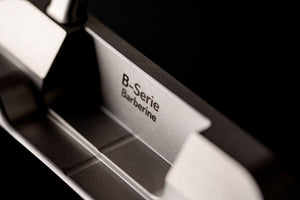
With a curved face, you get the same feel and sightline, and the face compensates for your hand variation. The B-Serie is a blade with the traditional sightline. Toe hang for a natural arc. Curved face for loft compensation.
You play a straight stroke
You want face balanced. A mallet.
With a flat face, you get maximum MOI and stability, but the same 1 to 2mm vertical sweet spot as everything else.
With a curved face, you get that stability plus a 6mm vertical sweet spot and consistent loft at impact. The E-Serie is the most configurable mallet in the lineup. The L-Serie adds MLA's patented alignment pattern for golfers who want precision on aim and distance.
You play a slight arc (most golfers)
You want a mid-mallet. Some toe hang, but not too much. The M-Serie is the all-rounder. The Z-Serie has the widest body and deepest center of gravity for maximum forgiveness. The C-Serie is compact for golfers who want stability without the bulk.
Not sure about your stroke?
Send us three video clips and our team will analyze your stroke for free. We will recommend the exact shape, shaft position, lie angle, weight, and alignment. Matched to how you actually putt.
Quick Comparison
| Blade | Mid-Mallet | Mallet | |
|---|---|---|---|
| Head size | Compact | Medium | Large |
| Best for | Arc stroke | Slight arc | Straight stroke |
| Horizontal forgiveness | Low | Medium | High |
| Feel / feedback | High | Medium | Lower |
| Alignment aids | Minimal | Moderate | Extensive |
| Balance | Toe hang | Varies | Face balanced |
| Vertical sweet spot (flat face) | 1-2mm | 1-2mm | 1-2mm |
| Vertical sweet spot (curved face) | ~6mm | ~6mm | ~6mm |
| myvicto model | B-Serie | Z, M, C-Serie | E, L-Serie |
Frequently Asked Questions
Is a mallet or blade putter better for beginners?
A mallet is generally more forgiving. Higher MOI, more alignment aids. But the shape only addresses horizontal forgiveness (toe-heel). If you want distance consistency too, look at the face. A curved face gives you vertical forgiveness that no flat face mallet can. The E-Serie (mallet) and M-Serie (mid-mallet) are solid starting points for beginners.
What type of putter do most pros use?
Both. Some prefer blades, some prefer mallets. The trend is that pros care less about shape and more about face technology and distance control. What the ball does in the first moments after impact matters more than how the putter looks at address.
Is a mallet putter more forgiving?
On the horizontal axis (left-right mishits), yes. A mallet has higher MOI. On the vertical axis (high-low mishits), it depends entirely on the face. A flat face mallet and a flat face blade have the same 1 to 2mm vertical sweet spot. A curved face expands that to 6mm regardless of head shape.
How do I know which putter suits my stroke?
Film yourself putting from behind. If the putter arcs open and closed, you have an arc stroke (blade or mid-mallet with toe hang). If it moves straight back and through, you have a straight stroke (face balanced mallet). If you are not sure, send us a video and we will tell you.
What is face balanced vs toe hang?
Balance your putter shaft on your finger. If the face points straight up: face balanced (suits straight strokes). If the toe drops: toe hang (suits arc strokes). More toe hang means more suited to a pronounced arc.
What is putter loft and why does it matter?
Putter loft is the angle of the face relative to vertical. Typically 2 to 4 degrees. It lifts the ball out of its resting depression and gets it rolling. The problem: that loft only works perfectly at one hand position. Move your hands forward or back by a few millimeters and the effective loft changes. A curved face varies the loft across the face to compensate for these natural variations. Full explanation here.
What is the vertical sweet spot?
The zone on the face where the energy transfer stays consistent from top to bottom. On a flat face: 1 to 2mm. On a curved face: approximately 6mm. Three to six times larger. This is why two putts with the same stroke can travel different distances with a flat face. See the data.
The Bottom Line
Blade or mallet? That question matters. Match your stroke type. Pick the shape you feel confident over.
But the bigger question is what the face does at impact.
Every flat face putter has one loft and a 1 to 2mm vertical sweet spot. Your hands shift under pressure. The launch angle changes. Your distance becomes unpredictable. This happens whether you chose blade or mallet.
A curved face adapts. The loft compensates. The sweet spot expands to 6mm. The ball contacts above the equator. Skid is reduced. Distance becomes consistent.
The shape matches your stroke. The face determines your distance.
When you are choosing your next putter, get both right.
Every myvicto putter has a curved face. You choose the shape. The face does the rest.
See how the curved face works | Find which myvicto fits your stroke | Browse the full lineup